
Portrait tattoo artist San Francisco


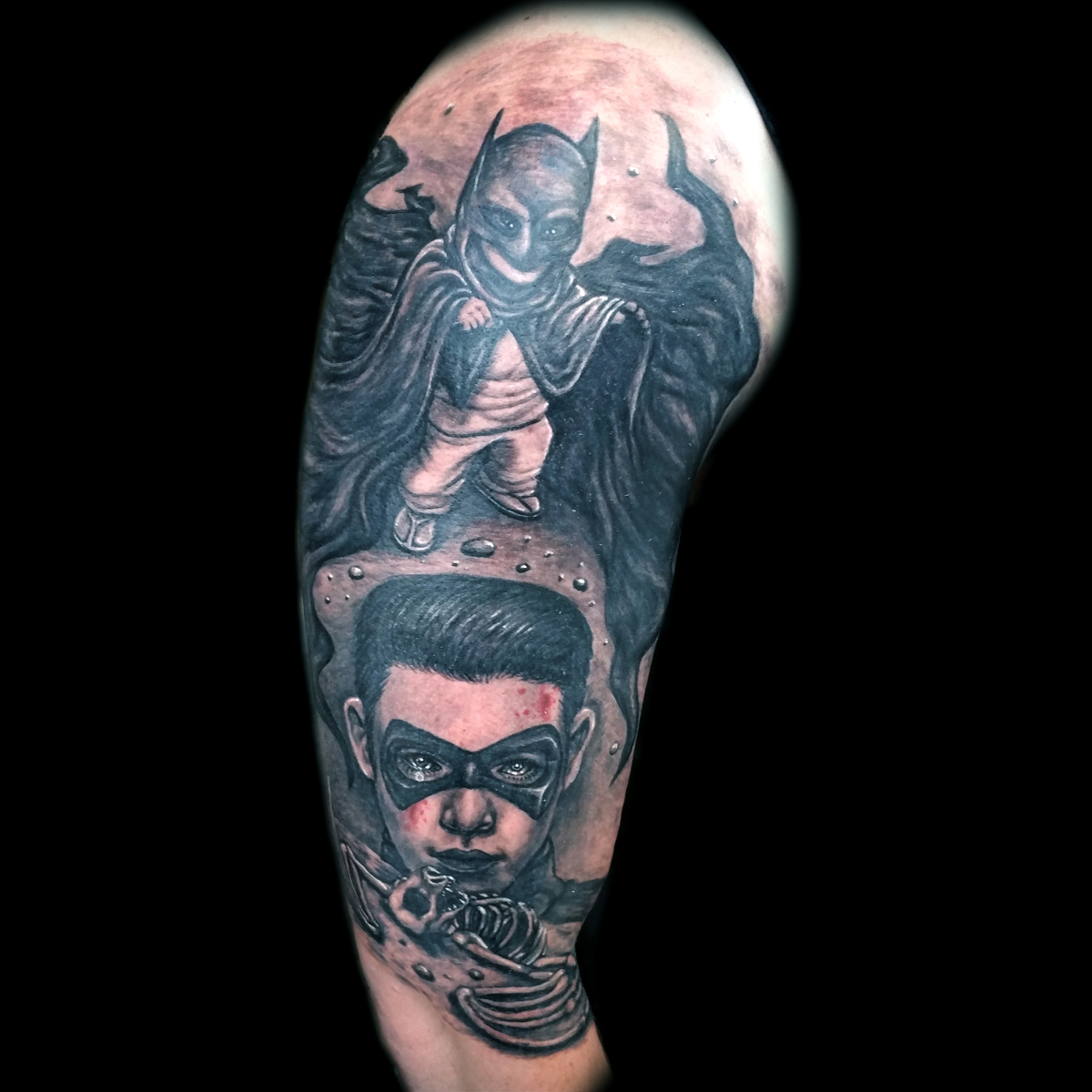
Realistic Portrait Tattoos – Custom Portrait Tattoo Art by Brian Martinez in San Francisco
A realistic portrait tattoo can preserve a face, memory, relationship, or meaningful moment through detailed artwork. When the proportions, expression, lighting, skin texture, and shadows come together correctly, a portrait can look remarkably lifelike on the skin.
At Masterpiece Tattoos in San Francisco, tattoo artist Brian Martinez specializes in realistic, 3D, portrait, black and gray, color, and custom tattoo artwork. His approach focuses on studying the visual information within a reference photograph and translating those details into realistic shading, contrast, texture, and dimensional effects.
Portrait tattoos can commemorate a loved one, celebrate a family member, honor someone who has passed away, or showcase an admired public figure. In addition, the design can incorporate flowers, animals, landscapes, religious imagery, dates, or other elements that make the tattoo more personal.
What Makes a Realistic Portrait Tattoo Different?
A realistic portrait requires precision.
The face contains many small relationships between the eyes, nose, mouth, cheekbones, forehead, and jawline. Even a subtle change in proportion can alter the likeness.
Therefore, portrait tattooing requires careful observation.
The artist needs to study the reference photograph before translating it onto skin. Lighting also matters because shadows define the shape of the face.
For example, a highlight across the cheek can create volume. A darker area beneath the cheekbone can establish depth. Meanwhile, subtle shading around the eyes can help preserve the person’s expression.
Brian Martinez uses these principles when developing realistic portrait tattoos.
Explore the realism tattoo collection to see more examples of realistic artwork.
Brian Martinez’s Approach to Portrait Tattoos
A strong portrait tattoo begins with understanding the reference image.
Brian studies the important visual information within the photograph. From there, he considers proportions, lighting, facial structure, texture, and contrast.
Instead of treating the photograph like a simple picture to copy, the image becomes a guide for creating the tattoo.
This distinction matters because skin is different from paper or a digital screen.
The artist must consider how the image will age, how different values will translate onto skin, and how the design will work with the body’s natural shape.
Consequently, the final portrait needs both artistic accuracy and tattoo-specific planning.
Realistic Black and Gray Portrait Tattoos
Black and gray is one of the most popular approaches to portrait tattooing.
Without color competing for attention, the viewer can focus on facial structure, expression, lighting, and texture.
Deep blacks can create dramatic shadows. Gray gradients can reproduce subtle changes across the face. Carefully placed highlights can then emphasize important features.
This style works particularly well for memorial portraits and classic photographic images.
Furthermore, black and gray portraits can create a timeless appearance.
For clients who prefer monochromatic artwork, explore the black and gray realism tattoo collection.
Color Realistic Portrait Tattoos
Color can add another level of realism to a portrait.
Natural skin tones, hair colors, clothing, and environmental details can all contribute to the final composition.
However, realistic color requires careful control.
Skin should not appear as one flat color. Instead, subtle variations can create a more natural appearance. Shadows can become warmer or cooler depending on the lighting, while highlights can bring the face forward.
Brian can combine realistic color with strong tonal values to preserve depth.
As a result, a color portrait can maintain the dimensional quality expected from realistic tattooing.
Explore the color realism tattoo gallery for more examples.
Realistic Family Portrait Tattoos
Family portraits are among the most meaningful types of portrait tattoos.
A tattoo can preserve the image of a parent, child, grandparent, spouse, sibling, or another important family member.
The reference photograph may come from a recent moment. Alternatively, an older photograph can become the foundation for the tattoo.
Several portraits can also be combined into one composition.
For example, multiple family members can appear together within a larger realistic design. Flowers, dates, names, or meaningful backgrounds can then connect the portraits.
Because every family has its own story, the final composition can be completely customized.
Memorial Portrait Tattoos
A realistic portrait can also serve as a permanent memorial.
For someone who has lost a loved one, a portrait can preserve their face and expression in a deeply personal way.
The design may remain simple and focus entirely on the face. Alternatively, additional elements can communicate something about the person’s life.
Flowers, religious symbols, favorite animals, landscapes, dates, or handwritten elements can become part of the composition.
However, the portrait should remain the main focal point.
Therefore, supporting elements should enhance the memory without distracting from the person’s likeness.
Realistic Celebrity Portrait Tattoos
Portrait tattoos can also celebrate musicians, actors, athletes, artists, and other public figures.
A strong reference photograph can capture a recognizable expression or memorable moment.
For celebrity portraits, choosing the right photograph is particularly important.
The image should provide clear facial details and appropriate lighting. A blurry or heavily filtered photograph can make realistic tattooing more difficult.
Once a strong reference is selected, Brian can use the facial structure, lighting, and expression as the foundation for the tattoo.
Realistic Athlete Portrait Tattoos
Athletes provide another popular subject for realistic portraits.
A tattoo might feature a favorite football player, basketball player, baseball player, boxer, soccer player, or another sports figure.
The portrait can remain focused on the face. Alternatively, the athlete can appear in action.
For a larger tattoo, the portrait can be combined with a jersey number, equipment, stadium, or memorable moment.
This creates a design that celebrates both the person and the sport.
Explore the realistic sports tattoo collection for additional inspiration.
Realistic Portraits With Flowers
Flowers can frame a portrait beautifully.
Roses, lilies, peonies, sunflowers, and other flowers can surround the face without competing with the main subject.
The flowers can also introduce color or additional texture.
For example, a black and gray portrait can be surrounded by realistic roses. Alternatively, a color portrait can incorporate vibrant flowers that match the overall theme.
Furthermore, flowers can carry their own symbolism.
A specific flower may represent love, family, remembrance, or another personal meaning.
Explore the realistic floral tattoo collection for related ideas.
Portrait Tattoos With Animals
An animal can add another layer of meaning to a portrait tattoo.
A client may want to combine a person’s portrait with their favorite animal. Alternatively, the animal could represent a particular quality associated with the person.
Wolves, lions, bears, eagles, owls, dogs, horses, and other animals can become part of the composition.
The challenge involves balancing both realistic subjects.
The face may remain the primary focal point while the animal supports the surrounding composition.
As a result, the tattoo can tell a more complete story.
Realistic Portrait Tattoos With Backgrounds
A background can dramatically change the feeling of a portrait.
A simple dark background can make the face stand out. Meanwhile, a realistic landscape can place the person within a meaningful environment.
Other possibilities include:
- Clouds
- Forests
- Mountains
- Architecture
- Flowers
- Smoke
- Water
- Textures
- Abstract shadows
- Religious imagery
However, background elements should usually remain softer than the portrait.
This creates depth while keeping attention on the face.
3D Realistic Portrait Tattoos
Portraits can also benefit from three-dimensional tattoo techniques.
The face can appear to rise from the skin. Shadows around the edges can create separation, while highlights can make the forehead, nose, cheekbones, or other features appear closer.
Brian Martinez uses contrast, lighting, shadows, and tonal transitions to create dimensional effects.
Consequently, a portrait can appear more like a physical image than a flat tattoo.
This approach can be especially effective when combined with realistic backgrounds.
Explore the 3D tattoo collection for more examples of dimensional work.
Realistic Portrait Tattoos Without Heavy Outlines
Traditional tattoo styles often use clear outlines to define an image.
Realistic portraiture works differently.
Instead of outlining every facial feature, the artist can use changes in value to establish form.
A shadow can separate the nose from the cheek. A darker eyelid can define the eye. Subtle changes around the mouth can establish the expression.
This technique allows the portrait to develop naturally.
Furthermore, eliminating heavy outlines can help the tattoo maintain a photographic appearance.
Choosing the Right Portrait Photograph
The reference photograph is one of the most important parts of the process.
A high-quality image gives the artist more information to work with.
Ideally, the photograph should show:
- Clear facial features
- Good lighting
- Sharp details
- Natural proportions
- A recognizable expression
- Minimal distortion
Multiple photographs can also help.
One image might provide the best facial expression. Another could provide better lighting or reveal details hidden in the first photograph.
Brian can use those references to develop a stronger custom composition.
Realistic Portrait Tattoos From Old Photographs
Not every meaningful photograph needs to be recent.
Older family photographs can become beautiful portrait tattoos.
However, vintage images may have lower resolution or missing details.
In those situations, the artist may need to interpret the available information carefully.
The goal is not simply to reproduce imperfections from an old photograph. Instead, the reference provides the foundation for recreating the person’s recognizable features.
This can make an old memory suitable for a modern realistic tattoo.
Realistic Portrait Sleeves
A portrait can become the centerpiece of an entire sleeve.
The face may occupy the upper arm while flowers, animals, dates, landscapes, or other meaningful elements continue down the arm.
Background shadows can connect the different subjects.
For example, clouds can transition from the portrait into a landscape. Flowers can frame the face while their leaves continue toward the forearm.
This approach creates a unified composition.
Explore the custom sleeve tattoo portfolio for larger project ideas.
Realistic Portrait Chest Tattoos
The chest provides a broad area for detailed portrait work.
A large portrait can occupy one side of the chest. Alternatively, multiple portraits can create a larger family composition.
The natural shape of the chest should influence the placement.
A face positioned too close to a fold or curve may distort when the body moves. Therefore, careful planning can help preserve the portrait’s proportions.
Additional elements can then extend toward the shoulders.
Realistic Portrait Back Pieces
The back offers enough space for large-scale portrait compositions.
A central portrait can become the main focal point while supporting imagery surrounds it.
For example, a large memorial portrait could include flowers, clouds, a meaningful landscape, or other personal symbols.
Large-scale placement also provides more room for subtle facial shading.
As a result, the artist can develop additional texture and tonal transitions without overcrowding the design.
Realistic Portrait Forearm Tattoos
The forearm can be an excellent location for a single portrait.
Its vertical shape can accommodate a face with supporting elements above and below.
However, the portrait should be large enough to preserve important facial details.
Small facial features can become difficult to maintain if the design becomes too small.
Therefore, size should be determined according to the desired level of realism.
Realistic Portrait Cover-Up Tattoos
Portraits can sometimes provide creative possibilities for cover-ups.
Dark hair, clothing, backgrounds, shadows, and other elements can help incorporate existing ink into a new composition.
However, portrait cover-ups require careful planning.
The original tattoo’s saturation, size, and placement can determine whether a portrait is suitable.
Brian can evaluate the existing artwork before developing the final concept.
For more information, explore the realistic cover-up tattoo page.
Creating an Original Portrait Tattoo
A realistic portrait tattoo should feel personal.
Instead of simply copying another tattoo, the design can incorporate meaningful elements connected to the subject.
Perhaps the person loved a particular flower. Maybe they had a favorite animal or place. Another possibility involves combining several photographs into one composition.
Brian Martinez can use those ideas to develop custom artwork.
Reference images provide the foundation. From there, the composition can be adjusted for placement, size, lighting, and style.
As a result, the finished tattoo can become more than a portrait. It can become a visual story.
Why Experience Matters With Realistic Portrait Tattoos
Portrait tattooing requires exceptional attention to detail.
Facial proportions need to remain accurate. Expressions must feel natural. Shadows should follow the structure of the face. Highlights need to appear consistent with the original lighting.
At the same time, the design must translate properly onto skin.
Brian Martinez has more than 17 years of tattooing experience and specializes in realistic and surrealistic artwork.
His approach involves breaking down the visual information in a reference image and translating it through shading, contrast, texture, and tonal values.
Therefore, the goal is not simply to reproduce a photograph. Instead, the objective is to create a realistic tattoo that preserves the character and expression of the subject.
Start Your Realistic Portrait Tattoo in San Francisco
A realistic portrait tattoo can preserve love, family, memories, inspiration, achievement, remembrance, or the image of someone important.
The design can remain focused on a single face. Alternatively, it can become a larger composition featuring flowers, animals, landscapes, sports imagery, religious elements, or other personal details.
At Masterpiece Tattoos in San Francisco, Brian Martinez creates custom realistic portrait tattoos based on each client’s reference images, ideas, and preferred placement.
Whether you want a family portrait tattoo, memorial portrait, celebrity portrait, athlete portrait, black and gray portrait, color portrait, 3D portrait, portrait sleeve, or large portrait tattoo, the artwork can be developed specifically around your vision.
Explore the Brian Martinez tattoo portfolio, learn more about Brian Martinez, view the realism tattoo collection, or explore 3D tattoo designs.
Masterpiece Tattoos is located in San Francisco, California, and works by appointment.
If you are searching for a realistic portrait tattoo artist in the San Francisco Bay Area, bring your favorite photographs, personal ideas, and meaningful references to a consultation with Brian Martinez. Together, those references can become an original portrait tattoo designed specifically for you and the natural shape of your body.