
Masterpiece Tattoo- Artists portfolios
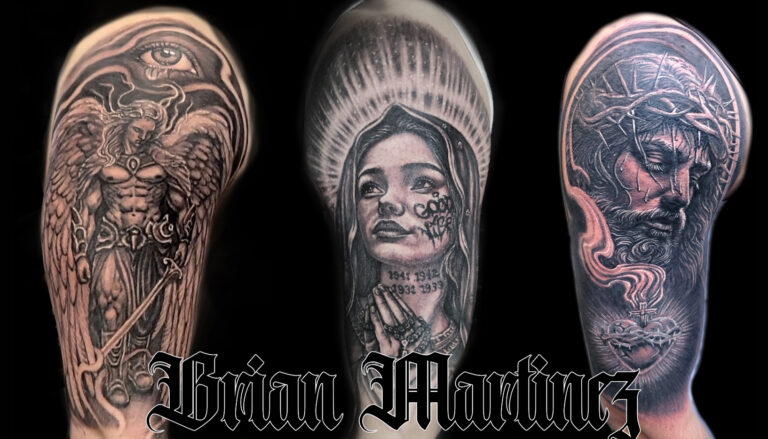
Brian Martinez – Realism Tattoo Artist and Owner of Masterpiece Tattoos in San Francisco
Choosing a tattoo artist is an important decision. A tattoo is permanent, so the artist you choose can have a major impact on the final result. Experience, artistic ability, attention to detail, and a strong understanding of realism all matter when creating highly detailed tattoo artwork.
Brian Martinez is a professional tattoo artist and the owner of Masterpiece Tattoos in San Francisco, California. His work focuses primarily on realistic and surrealistic tattoo art, including realistic portraits, animals, 3D designs, color realism, black and gray realism, and custom cover-ups.
With more than 17 years of experience in tattooing, Brian has developed a distinctive approach based on studying real-life images and translating their visual information onto the skin. His passion for realism began early in his life through drawing and observing the world around him. Eventually, that interest developed into a career dedicated almost entirely to realistic tattooing.
Today, his work attracts clients looking for detailed custom tattoos rather than generic designs.
From Drawing to Professional Tattooing
Brian’s interest in art began long before he became a professional tattoo artist.
Born in Montevideo, Uruguay, he developed an early interest in drawing from observation. He enjoyed trying to reproduce real objects, people, and details as accurately as possible.
That interest eventually influenced the way he approaches tattooing.
Brian began tattooing professionally after spending time learning from different artists and observing their techniques. His exposure to many tattoo styles helped him understand what he enjoyed most about the craft.
Realism quickly became the direction he wanted to pursue.
Instead of concentrating on traditional line-based designs, Brian became interested in replicating photographs and creating images that could appear three-dimensional on the skin.
That focus eventually became the foundation of his career.
Today, his portfolio includes realistic portraits, animals, surrealistic concepts, biomechanical designs, dark art, and many other custom subjects.
A Tattoo Artist Focused on Realism
Realism requires a different mindset from many other tattoo styles.
Rather than depending primarily on outlines, realistic artwork relies heavily on value, contrast, texture, lighting, and carefully controlled transitions.
Brian’s approach begins by breaking down the visual information in an image.
He studies the reference photograph and identifies the important characteristics that need to be reproduced. These can include facial proportions, lighting, shadows, textures, expressions, and the relationship between light and dark areas.
The same process can be applied to animals, objects, landscapes, and other subjects.
For example, creating a realistic tiger requires more than drawing stripes. The artist must understand the animal’s anatomy, fur direction, facial structure, eyes, lighting, and natural shadows.
A realistic portrait presents a similar challenge.
Small changes to the eyes, nose, mouth, or proportions can alter the likeness of a person. Therefore, precision becomes especially important.
You can explore examples of this approach through our realistic tattoo portfolio.
The Art of Realistic Portrait Tattoos
Portrait tattoos are among the most demanding projects an artist can undertake.
A portrait needs to look like the person it represents. Even a small proportion issue can change the expression or identity of the subject.
Brian Martinez has developed a strong focus on realistic portrait tattoos.
His process involves carefully studying the reference photograph and translating its visual information into a tattoo composition. Lighting and contrast are particularly important because they help establish the structure of the face.
Portrait tattoos can also carry tremendous emotional meaning.
A client may choose a portrait to remember a parent, child, partner, friend, pet, or another important person. Others may choose an actor, musician, athlete, or other public figure they admire.
Regardless of the subject, the goal is to create artwork that captures the characteristics that make the image recognizable.
Brian also considers how the portrait should interact with the surrounding body.
A portrait does not necessarily need to exist by itself. Background elements, textures, flowers, smoke, clouds, objects, or other imagery can be incorporated to create a larger composition.
Visit our portrait tattoo gallery to see examples of custom portrait work.
Creating 3D Tattoos Without Traditional Outlines
One of the most recognizable aspects of Brian Martinez’s approach is his use of contrast and shading to create three-dimensional effects.
Traditional tattoo designs often rely on outlines to define their shapes.
Brian takes a different approach with his realism work.
Instead of using heavy outlines to separate every element, he can use changes in value, color, highlights, and shadows to make shapes appear dimensional.
Think about the way light interacts with a physical object.
One side may be brightly illuminated while another side falls into shadow. That difference gives the object volume.
The same principle can be applied to tattoo artwork.
A realistic rose can appear to have raised petals. A butterfly can look as though it is sitting above the skin. A skull can appear to emerge from darkness. A mechanical object can be designed to look as though it has physical depth.
This technique is not limited to one particular subject.
Brian has used dimensional realism for animals, objects, biomechanical concepts, fantasy artwork, and many other custom designs.
See more examples on our 3D realism tattoo page.
Black and Gray Realism
Black and gray realism is another important part of Brian’s portfolio.
Working without color places even more emphasis on values and contrast.
The artist must determine where the darkest blacks should be placed, where softer gray transitions are needed, and where the natural skin can become part of the image.
This can produce dramatic results.
Black and gray realism works especially well for portraits, wildlife, skulls, religious imagery, landscapes, memorial pieces, and darker artistic concepts.
The technique can also be combined with strong backgrounds.
A portrait, for example, can be surrounded by clouds, smoke, architecture, flowers, or other elements that help establish the overall mood.
The result can be a complete composition rather than a single isolated image.
Color Realism With Depth and Dimension
Brian also creates realistic color tattoos.
Color introduces another layer of complexity because the artist must control both hue and value.
A realistic tattoo needs more than bright colors.
The artist has to understand how colors interact with one another and how highlights and shadows affect the appearance of an object.
This is particularly important with subjects such as flowers, animals, birds, underwater scenes, portraits, and fantasy artwork.
Color can also be used strategically.
Bright areas can attract attention toward the focal point of the design. Darker areas can create separation and depth.
When these elements are balanced correctly, the tattoo can maintain a realistic appearance while still having visual impact.
Custom Cover-Up Tattoo Transformations
Cover-up tattooing requires creativity as well as technical experience.
An existing tattoo cannot simply be erased from the design process. The old ink remains underneath the new artwork, which means the artist must understand its shape, darkness, and placement.
Brian approaches cover-ups by examining the existing tattoo before developing the new concept.
The existing dark areas may become shadows. Certain shapes may be incorporated into hair, fur, feathers, foliage, clouds, or other textures.
The objective is to create a new composition that does not look like a patch covering an old tattoo.
Instead, the finished artwork should look intentional.
This can be particularly challenging when the original tattoo is large, heavily saturated, or has strong linework.
However, creative composition and realistic shading can provide opportunities to transform unwanted artwork into something completely different.
If you are considering changing an existing tattoo, explore our cover-up tattoo portfolio.
A Personalized Approach to Every Tattoo
Brian Martinez does not approach every tattoo in exactly the same way.
Different subjects require different techniques.
A portrait may require precision and subtle facial shading. An animal may require detailed texture and anatomy. A 3D design may depend on dramatic lighting and shadows.
Large-scale projects introduce additional considerations.
The artwork needs to follow the shape of the body while maintaining visual balance. Elements should connect naturally instead of appearing randomly placed.
This is especially important for sleeves, back pieces, chest pieces, and other large compositions.
The initial concept can therefore evolve during the design process.
The client’s idea provides the starting point. Brian’s artistic experience can then help determine how the elements should be arranged to produce a stronger final composition.
Why Experience Matters
Tattooing is both an artistic and technical discipline.
An artist needs to understand composition, anatomy, lighting, skin, tattoo machines, ink, healing, and the way different techniques affect the final appearance.
Experience becomes particularly valuable when working on complicated projects.
Brian Martinez has spent many years developing his approach to realism. His portfolio demonstrates a wide variety of subjects, from portraits and animals to surrealistic and biomechanical designs.
That variety allows him to approach each project according to its specific requirements.
A tattoo does not have to fit into a predetermined template.
The technique can change according to the concept.
A Private, Appointment-Focused Experience
Masterpiece Tattoos operates as an appointment-focused studio in San Francisco.
The studio’s approach is designed around giving clients focused attention rather than treating every appointment like a quick walk-in service. The studio emphasizes cleanliness, professionalism, and personalized tattoo sessions.
This approach can be particularly useful for detailed realism.
Large tattoos can require long sessions. Portraits require concentration. Cover-ups often require careful planning.
Giving the artist adequate time to work can therefore be an important part of producing detailed artwork.
Clients also benefit from having an opportunity to discuss their concept before the tattoo begins.
Brian Martinez and Masterpiece Tattoos
Brian Martinez is not only the artist behind the work. He is also the owner and operator of Masterpiece Tattoos in San Francisco.
That means his artistic approach is closely connected to the identity of the studio.
Masterpiece Tattoos focuses on realism, custom artwork, portraits, 3D designs, and cover-up projects.
The studio is located in San Francisco’s Mission District, and clients travel from throughout the Bay Area and beyond for custom tattoo projects.
For clients looking for an artist who specializes in realistic artwork, having a clearly defined artistic direction can be important.
Brian’s focus is not on trying to offer every possible tattoo style.
Instead, his work centers on the areas where he has developed his strongest artistic identity.
A Style Built Around Realistic Detail
What makes Brian Martinez’s work distinctive is the combination of realism, contrast, and dimensionality.
His tattoos are designed to reproduce the appearance of real subjects while adapting those subjects to the human body.
The objective is not simply to create a detailed picture.
The artwork needs to function as a tattoo.
That means considering placement, scale, skin, contrast, composition, and how the design will look from different angles.
This is especially important with large pieces.
A successful tattoo should work as a complete composition while also maintaining strong detail when viewed up close.
Explore Brian Martinez’s Tattoo Portfolio
One of the best ways to understand an artist’s style is to look at the actual work.
Brian’s portfolio includes a broad selection of realistic and surrealistic tattoos. His work includes portraits, animals, 3D concepts, biomechanical artwork, dark art, color pieces, and custom designs.
You can explore the Brian Martinez tattoo portfolio to see different examples and discover ideas for your own project.
If you are specifically interested in realistic portraits, visit our portrait tattoo collection.
For dimensional artwork, explore our 3D tattoo collection.
And if you have an old tattoo that you want to transform, take a look at our realistic cover-up work.
Start Your Custom Tattoo Project With Brian Martinez
A great tattoo starts with a good idea, but the right artist can determine how that idea becomes a finished piece of artwork.
Brian Martinez brings more than 17 years of tattooing experience and a strong specialization in realism to his work in San Francisco. His portfolio reflects a commitment to realistic detail, custom compositions, portraits, dimensional artwork, and creative cover-ups.
Whether you have a reference photograph, a rough concept, or a completely developed idea, the process can begin with a consultation.
Bring your inspiration and explain what you want your tattoo to represent.
From there, the artwork can be developed around the subject, placement, size, and style that best fit your project.
If you are searching for a realism tattoo artist in San Francisco, you can learn more about Brian through the Masterpiece Tattoos website, browse the complete tattoo portfolio, or explore individual galleries for realistic tattoos, portrait tattoos, 3D realism, and cover-up tattoos.
Brian Martinez and Masterpiece Tattoos are located in San Francisco, California, and work by appointment.
When the artwork matters, experience matters. When realism is the goal, choosing an artist whose portfolio matches your vision can make all the difference.