
Realistic Octopus Tattoo


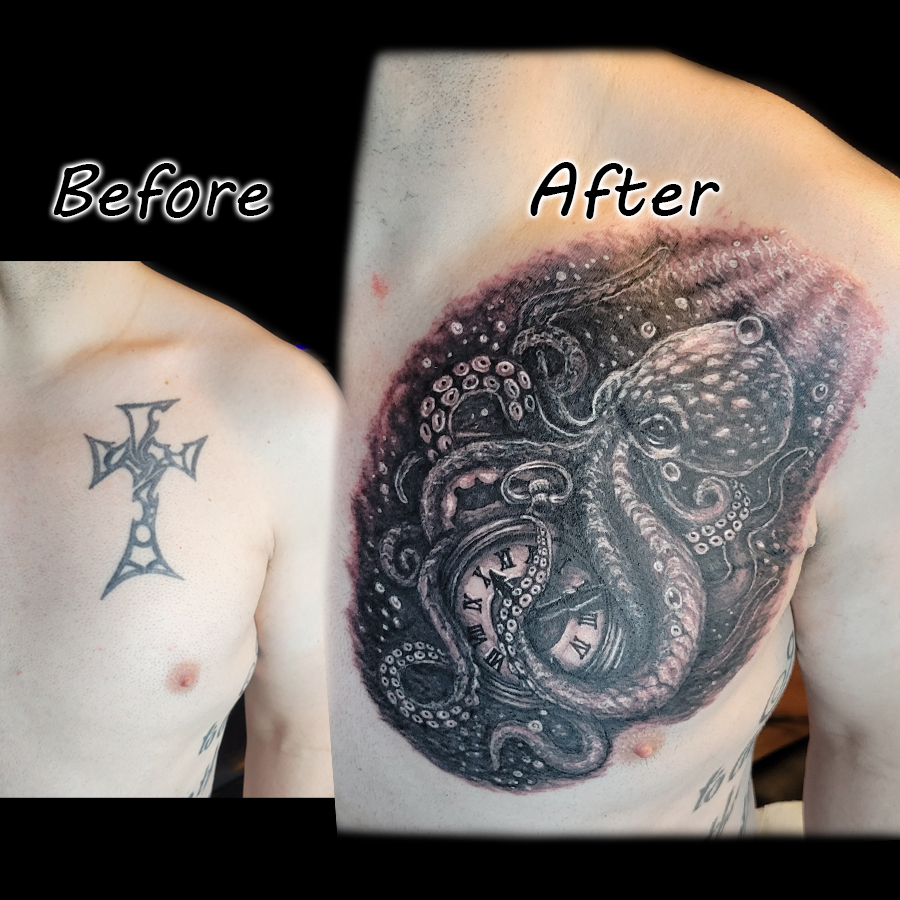


Realistic Octopus Tattoos in San Francisco: A Living Ocean on Your Skin
There is something naturally surreal about an octopus. Its flowing arms, textured skin, intelligent eyes, and ability to move through water give tattoo artists an extraordinary subject to work with. Realistic octopus tattoos can capture those qualities while creating the illusion that the animal is moving across the body.
At Masterpiece Tattoos in San Francisco, Brian Martinez approaches octopus artwork as a study of movement, texture, light, and anatomy. Rather than treating the tentacles as simple decorative elements, each one can become part of the composition. The result is a tattoo that feels fluid, dimensional, and connected to the shape of the body.
For more examples of realistic artwork, visit the Brian Martinez tattoo portfolio.
An Animal Made for Tattoo Art
Few sea creatures offer as much compositional freedom as the octopus.
Eight arms can spread across curved areas of the body. They can overlap, twist, disappear behind other elements, and return somewhere else in the design.
That movement creates opportunities that a single rigid subject cannot provide.
Additionally, the octopus has a highly recognizable silhouette. Even when the tentacles become part of a larger scene, the animal remains easy to identify.
The Head Becomes the Focal Point
A realistic octopus tattoo often begins with the eyes.
They provide personality and immediately establish the direction of the design. Subtle reflections can make the eyes appear wet and lifelike, while surrounding shadows create depth.
From there, attention moves toward the mantle and tentacles.
The head should remain strong enough to anchor the composition. Meanwhile, the arms can gradually become softer as they move toward the background.
This difference in detail helps establish visual hierarchy.
Tentacles Create Natural Movement
The arms are what make an octopus tattoo especially interesting.
Instead of arranging them evenly, a custom composition can give every tentacle a different position. Some may curl tightly. Others can extend outward or disappear behind another element.
Because of this variation, the tattoo can feel like a snapshot of an animal in motion.
Body placement also becomes important. A tentacle can follow the natural curve of an arm, shoulder, thigh, or torso.
The Suckers Tell the Story
An octopus has incredible surface detail.
Hundreds of suckers create repeating patterns along the underside of its arms. However, those details should not all receive identical emphasis.
Suckers closer to the viewer can receive stronger definition. Further away, they can become subtler.
As a result, the tattoo gains depth without becoming visually overwhelming.
Realistic Skin Texture
The texture of an octopus can change depending on lighting and perspective.
Subtle variations across the skin give the animal a more organic appearance. Small highlights can describe moisture, while darker areas define the folds and curves.
Moreover, careful shading can make the head appear rounded rather than flat.
For more detailed animal artwork, explore the realistic tattoo collection.
Water Changes Everything
An octopus does not need to be shown in an empty background.
Water can transform the entire atmosphere.
Soft currents can surround the tentacles. Small bubbles may create depth. Light rays can enter from above while the lower portion becomes progressively darker.
This creates a sense of underwater distance.
For a more cinematic composition, the background can include rocks, coral, shipwreck elements, or a deep ocean floor.
An Octopus Beneath the Surface
One striking concept places the viewer above the water while the octopus remains underneath.
The upper portion can show light breaking through the surface.
Below that boundary, the octopus becomes darker and more atmospheric.
This contrast creates an immediate sense of depth. It also gives the tattoo the feeling of looking into an actual underwater environment.
Deep-Sea Octopus Concepts
Not every octopus tattoo needs bright tropical colors.
A deep-sea concept can use darkness as part of the design.
The creature may emerge from an almost black environment, with selective highlights revealing its eyes and tentacles.
Small details can appear gradually as the viewer looks closer.
This approach works especially well with black and gray realism.
Black and Gray Octopus Tattoos
Black and gray provides excellent control over underwater depth.
Dark values can establish the deepest areas. Medium tones describe the octopus itself. Small highlights then separate the creature from the background.
Without relying on heavy outlines, changes in value can define the arms and suckers.
The finished design can therefore have a photographic quality.
For additional inspiration, explore the black and gray realism tattoo collection.
Color Can Bring the Ocean to Life
Color creates another direction.
Blue water can surround the octopus while warmer tones appear across its skin. Purple, red, orange, or brown tones can emphasize natural variations.
However, the strongest color compositions usually maintain a clear focal point.
Too much saturation across every element can flatten the scene.
Instead, selected areas can receive stronger color while the background remains more subdued.
Octopus and a Shipwreck
A shipwreck creates an immediate sense of scale.
The octopus can wrap around broken wood or metal while its tentacles disappear into the darkness.
Barnacles, ropes, bubbles, and underwater debris can provide additional texture.
Meanwhile, the animal remains the central subject.
This concept works particularly well for a large arm, thigh, chest, or back tattoo.
Octopus and a Treasure Chest
Another approach combines the animal with a sunken treasure chest.
One tentacle might curl around the chest.
Another can disappear behind it.
Small particles floating through the water create atmosphere.
Rather than making the treasure the primary subject, the octopus can remain dominant while the chest supports the underwater story.
Octopus With a Compass
A compass introduces a completely different meaning.
The octopus represents the ocean, while the compass can represent direction, exploration, or finding a path.
One tentacle could wrap around the compass.
Another option places the compass beneath the animal, almost as though it has become part of the ocean floor.
This combination can work especially well for someone with a connection to travel or the sea.
Octopus and a Pocket Watch
Time and the ocean create an unusual pairing.
A weathered pocket watch can sit beneath the tentacles. Water, rust, scratches, and reflections can make the object feel as though it has been underwater for years.
The octopus then becomes part of a larger story about memory, time, and things lost beneath the surface.
This type of composition can also incorporate 3D effects.
A Three-Dimensional Octopus
The tentacles naturally lend themselves to 3D tattoo techniques.
One arm can appear to cross over another element.
Another may seem to rest directly on the skin.
A cast shadow beneath the tentacle helps establish the illusion.
Highlights along the upper surface can then make the arm appear closer to the viewer.
Explore the 3D tattoo artist collection for more dimensional tattoo ideas.
Tentacles That Wrap Around the Body
An octopus can be designed specifically around anatomy.
For example, one tentacle could travel around the forearm. Another might curve toward the elbow.
On the shoulder, several arms can follow the natural roundness of the muscle.
A larger piece can even allow the tentacles to connect different sections of a sleeve.
This approach makes the body part of the composition.
A Full Octopus Sleeve
An octopus works particularly well as the central subject of a sleeve.
The head can sit on the upper arm while the tentacles travel toward the forearm.
Ocean elements can fill the spaces between the arms.
Rocks, bubbles, coral, fish, and shadows can provide transitions.
Consequently, the sleeve can tell one continuous underwater story.
Octopus Backpiece Designs
The back offers enough space for a much larger concept.
A giant octopus can occupy the center while its tentacles extend toward the shoulders and lower back.
The surrounding ocean can become progressively darker toward the edges.
Additional marine imagery can create scale without competing with the main animal.
Because the back is such a large canvas, realistic water effects can become an important part of the artwork.
A Giant Octopus and a Lighthouse
A lighthouse introduces an interesting contrast.
The building represents stability and direction. The octopus represents movement and the unpredictable ocean.
Tentacles can rise from the water while the lighthouse stands in the background.
Light beams crossing the scene can provide another opportunity for dramatic contrast.
This concept can work especially well as a large back or chest composition.
Marine Life in the Background
An underwater environment can contain additional creatures.
Small fish can create scale around the octopus.
Jellyfish can add movement and atmospheric depth.
A shark can introduce tension.
Sea turtles or rays can create a calmer scene.
Nevertheless, the background should support the octopus rather than compete with it.
Explore the realistic jellyfish tattoo collection for another marine-inspired subject.
Combining an Octopus With a Shark
An octopus and shark create an intense underwater composition.
The shark can occupy the distance while the octopus dominates the foreground.
Alternatively, tentacles can cross through the scene as the shark approaches.
Depth becomes especially important here.
The closest animal should receive the strongest detail. Distant elements can become softer.
That difference makes the ocean feel considerably larger.
An Octopus With a Skull
For a darker interpretation, an octopus can interact with a skull.
Tentacles might wrap around the bone.
One arm could pass through an eye socket.
The surrounding water can remain almost completely black.
This creates a dramatic combination of marine life and darker symbolism.
For more dark artwork, explore the horror tattoo collection.
Surrealistic Octopus Concepts
Realistic rendering does not mean the concept must remain ordinary.
The octopus could contain another world within its body.
Its tentacles might transform into tree roots.
An eye could appear inside one of the arms.
The animal might emerge from a human portrait or landscape.
These ideas combine realism with imagination while maintaining the natural anatomy of the creature.
Explore the surrealistic tattoo collection for more unconventional concepts.
Why Scale Matters
An octopus can become either a subtle tattoo or a dramatic centerpiece.
Small designs need to simplify the finer details.
Larger tattoos allow the artist to emphasize individual suckers, skin texture, eyes, and underwater elements.
For that reason, the desired level of realism should influence the size from the beginning.
Trying to reproduce too much detail in a tiny design can reduce clarity.
Choosing the Right Placement
The placement should match the movement of the tentacles.
A forearm works well for a vertical composition.
The shoulder provides a rounded area for the head.
A chest can accommodate a wider underwater scene.
Meanwhile, the back provides enough room for a large octopus with extended tentacles.
Designing specifically for the anatomy creates a more natural result.
Making the Ocean Feel Deep
Underwater realism depends heavily on atmosphere.
Objects closer to the surface can receive more detail.
Distant elements become softer and darker.
Particles in the water can create additional depth.
Light rays gradually disappear as they travel downward.
Together, these techniques can make a tattoo feel like a window into deep water.
The Importance of Contrast
An octopus tattoo can contain many dark areas.
Without careful contrast, the tentacles may merge into the background.
Highlights can separate overlapping arms.
Medium gray values can describe the body.
Deep shadows can remain in the spaces between tentacles.
As a result, the animal stays readable even within a complicated scene.
Designing Around Movement
The best compositions usually avoid making every tentacle point in the same direction.
Variation creates life.
One arm can curl inward. Another may stretch outward. A third could disappear behind the body.
That irregular movement makes the animal feel less like a graphic symbol and more like a living creature.
What an Octopus Can Symbolize
The octopus can carry many different meanings.
Its adaptability can represent resilience.
Its intelligence can suggest creativity.
Its ability to change color and appearance may symbolize transformation.
For others, the creature simply represents a love of the ocean.
The meaning does not have to be obvious to everyone. A custom tattoo can carry a personal message that only the wearer fully understands.
Creating a Tattoo From Your Own Idea
You do not need to arrive with a finished concept.
A photograph of an octopus can provide the starting point.
Perhaps you already have an idea involving a shipwreck, compass, clock, skull, or underwater landscape.
From there, the composition can be developed around your preferred placement.
That process allows the final design to feel much more personal than a generic image.
Brian Martinez and Realistic Tattoo Art
Brian Martinez has more than 17 years of tattooing experience and creates realistic, surrealistic, and 3D tattoo artwork at Masterpiece Tattoos.
His approach emphasizes realistic anatomy, lighting, texture, contrast, and dimensional shading.
Those techniques are particularly useful when working with complicated subjects such as octopuses.
Every tentacle can receive its own position, lighting, and relationship to the surrounding elements.
Explore the Brian Martinez tattoo portfolio to see examples of his artwork across different tattoo styles.
Create Your Octopus Tattoo in San Francisco
Realistic octopus tattoos offer an enormous amount of creative freedom. Flowing tentacles can wrap around the body, while realistic eyes, suckers, skin texture, water, and shadows create an incredibly detailed subject.
At Masterpiece Tattoos in San Francisco, Brian Martinez creates custom octopus artwork based on your preferred style, placement, concept, and references.
Whether you envision a realistic octopus, black and gray octopus, color octopus, 3D octopus, underwater octopus, giant octopus, octopus sleeve, octopus backpiece, octopus with a shipwreck, octopus with a skull, octopus with a compass, octopus and shark design, or surrealistic octopus tattoo, the composition can be developed specifically around your idea.
Explore the realistic tattoo collection, 3D tattoo collection, animal tattoo collection, landscape and nature tattoos, and dark tattoo collection for additional inspiration.
Masterpiece Tattoos is a private tattoo studio in San Francisco, California, and works by appointment.
Bring an octopus photograph, an idea, or several references that inspire you. Brian Martinez can use those starting points to create a custom composition designed specifically for your body.