
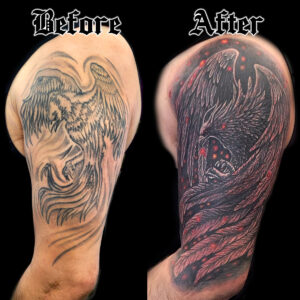

Phoenix bird tattoos
Phoenix Tattoo Artist San Francisco Bay Area | Realistic Phoenix Tattoos
A Phoenix tattoo is a powerful symbol of transformation, rebirth, and strength. Rising from flames, the mythical bird can represent a person leaving the past behind and beginning again. With realistic shading, dramatic fire, detailed feathers, and dimensional lighting, a Phoenix can become an unforgettable piece of custom tattoo art.
At Masterpiece Tattoos in San Francisco, Brian Martinez creates realistic Phoenix tattoos designed around the client’s story, placement, and preferred style. Rather than treating the Phoenix as a simple symbol, the artwork can become a complete visual composition.
The Meaning Behind a Phoenix Tattoo
Few tattoo subjects carry as much symbolism as the Phoenix.
Rebirth is one of its most recognizable meanings. Someone who has experienced a major change may choose this mythical bird as a reminder of starting over.
Strength is another important theme. The Phoenix survives destruction and rises again, making it a natural symbol for resilience.
For others, the imagery represents personal growth, freedom, courage, or transformation.
Because of this wide range of meanings, every Phoenix tattoo can tell a different story.
Realistic Phoenix Tattoo Design
Realism can give the mythical bird an almost physical presence.
Individual feathers can be rendered with layers of texture. Fire can surround the body with flowing movement. Highlights can then separate the Phoenix from the darker areas of the composition.
Lighting is especially important.
Bright areas of flame can create contrast against deep shadows. Subtle gradients can give the wings greater volume. Meanwhile, small feather details can make the bird look more natural.
As a result, the design can feel dynamic without becoming visually chaotic.
Phoenix Tattoos Rising From Fire
Flames are often the most recognizable part of a Phoenix composition.
However, realistic fire requires more than adding random shapes around the bird.
Flames should have direction and movement. Their brightness can also change across different areas of the tattoo.
For example, the fire closest to the Phoenix may contain brighter highlights. Areas farther away can gradually become darker and softer.
This technique creates depth while allowing the bird to remain the primary subject.
Phoenix Feather Detail
The quality of the feathers can dramatically affect a realistic Phoenix tattoo.
Large wing feathers provide strong shapes. Smaller feathers can add texture and transition between different areas.
Individual feather edges can be highlighted to create separation.
At the same time, darker areas between the feathers create depth.
A well-planned wing should look layered rather than flat.
That attention to texture becomes particularly important when the Phoenix covers a large area of the body.
Phoenix Wing Tattoos
Wings give the design a strong sense of movement.
A fully extended wing can create a wide composition across the chest or back. Folded wings offer a more compact design for the arm, thigh, or shoulder.
Body placement can therefore influence the pose.
For a sleeve, the wing might follow the natural direction of the arm. On the back, both wings can spread outward from the center.
Consequently, the same Phoenix concept can look completely different depending on its placement.
Black and Gray Phoenix Tattoos
Black and gray realism creates a darker interpretation of the Phoenix.
Instead of relying on bright flames, the design can use contrast to create the impression of fire and movement.
Deep blacks can define the darkest portions of the wings. Gray gradients can reveal feather texture. White or skin-tone highlights can then suggest glowing areas.
This approach works especially well for clients who want a powerful tattoo without bright colors.
Explore the black and gray tattoo collection for additional inspiration.
Color Phoenix Tattoos
Color opens another direction for Phoenix artwork.
Red, orange, yellow, and gold can create the classic fiery appearance. Richer tones can also be introduced into the feathers to make the bird feel more vibrant.
Nevertheless, color should be controlled.
A realistic Phoenix does not need every possible shade. Instead, a carefully selected palette can make the fire appear brighter and the bird more dimensional.
Warm colors can also be contrasted against darker surroundings.
That difference helps the Phoenix stand out from the skin.
3D Phoenix Tattoos
Three-dimensional shading can make the Phoenix appear as though it is emerging from the skin.
Strong cast shadows beneath the wings can create separation. Highlights along the feathers can make them appear closer to the viewer.
Fire can also be positioned around the body to strengthen the illusion.
Consistent lighting is essential for this effect.
If every element follows the same light source, the composition becomes much more believable.
For more dimensional tattoo inspiration, visit the 3D tattoo artist collection.
Phoenix and Skull Tattoos
A skull can create a darker interpretation of the rebirth theme.
Instead of showing only the bird rising from flames, the composition can include a skull beneath the Phoenix.
The contrast between bone and fire creates a dramatic visual.
Dark eye sockets provide natural areas of heavy shading. Cracks and realistic bone texture can add smaller details.
Meanwhile, the Phoenix can remain brighter above the skull.
This arrangement creates a visual story about death, transformation, and renewal.
Explore the realistic skull tattoo collection for additional dark tattoo ideas.
Phoenix and Snake Tattoos
Combining a Phoenix with a snake creates an unusual composition.
The bird represents renewal and rising above adversity. In contrast, the snake can symbolize transformation, change, or rebirth through shedding its skin.
Their forms can also complement each other visually.
A snake can curve around the lower portion of the Phoenix. The wings can then expand above it, creating movement in opposite directions.
With realistic shading, the different textures become even more interesting.
Feathers, scales, and fire each require a distinct approach.
Phoenix and Dragon Tattoos
For a more fantasy-inspired concept, the Phoenix can be combined with a dragon.
Both creatures can become major focal points. However, the composition needs careful planning so neither subject overwhelms the other.
One option places the Phoenix above the dragon. Another arrangement allows the two creatures to intertwine.
Fire, smoke, clouds, and atmospheric effects can connect the subjects.
Because the concept contains multiple elements, large placements such as the back, chest, or thigh can provide more room for detail.
Phoenix Sleeve Tattoos
A Phoenix can make an impressive centerpiece for a full sleeve.
The head and upper body can sit near the shoulder. Wings can extend across the upper arm, while flames and feathers move toward the forearm.
Dark smoke can fill smaller gaps.
Fire can also provide natural transitions between different sections.
Planning the sleeve as one composition is important. Every element should have a visual relationship with the next.
As a result, the completed tattoo can feel continuous instead of looking like separate images placed together.
Phoenix Chest Tattoos
The chest provides an excellent canvas for a wide-winged Phoenix.
An open-wing composition can follow the natural width of the chest. The head can sit near the center, creating a strong focal point.
Flames may extend toward the shoulders.
Alternatively, the wings can remain closer to the center for a more compact appearance.
Because the chest has a broad surface, realistic feather detail can be developed without making the artwork feel cramped.
Phoenix Backpiece Tattoos
A Phoenix backpiece allows the artist to create a much larger scene.
The bird can occupy the central portion of the back. Wings can extend toward the shoulders, while flames descend toward the lower back.
Smoke and atmospheric elements can fill the surrounding space.
Another approach places the Phoenix higher on the back, with a trail of fire moving downward.
Large-scale work also allows greater attention to facial details, feathers, and individual flames.
Therefore, the back can be an ideal placement for an elaborate Phoenix composition.
Phoenix Forearm Tattoos
A smaller Phoenix can work beautifully on the forearm.
The design can follow the length of the arm. The bird’s wings may spread outward, while the flames travel vertically.
For a smaller tattoo, unnecessary details should be reduced.
The most important features should remain clear from a distance.
A strong silhouette, recognizable wings, and carefully controlled shading can preserve the Phoenix’s identity even at a smaller scale.
Phoenix Shoulder Tattoos
The shoulder provides a natural rounded surface for wings.
A Phoenix can wrap around the shoulder while the body follows the upper arm.
This placement can create an interesting sense of movement.
As the arm moves, portions of the wings and flames can appear to shift with the body.
That natural interaction between artwork and anatomy is one reason custom placement matters.
Surrealistic Phoenix Tattoos
A Phoenix does not have to look completely traditional.
Surrealistic elements can transform the familiar symbol into something much more personal.
For example, the bird could emerge from a human face. Flames might transform into flowers. Feathers could gradually become smoke or clouds.
Another concept could combine the Phoenix with an unusual landscape or dreamlike environment.
Realistic rendering keeps these imaginative elements believable.
For clients interested in this direction, explore the surrealistic tattoo collection.
Phoenix and Flowers
Flowers can soften the powerful appearance of a Phoenix.
Roses, lilies, sunflowers, or other botanical elements can be incorporated into the flames or background.
A Phoenix surrounded by flowers can symbolize growth after hardship.
The contrast between delicate petals and fiery feathers also creates interesting texture.
Furthermore, floral elements can help connect separate sections of a larger tattoo.
Explore the realistic floral tattoo collection for additional ideas.
Phoenix Cover-Up Tattoos
Phoenix imagery can sometimes work well for tattoo cover-ups.
Dark feathers provide opportunities for heavier shading. Flames can also create areas of strong contrast.
Existing tattoo elements may occasionally be incorporated into the new composition.
However, every cover-up needs individual planning.
The size, color, saturation, and location of the original tattoo all affect the available options.
A successful cover-up should be designed around the existing ink rather than simply placed on top of it.
Learn more through the cover-up tattoo artist page.
Creating a Custom Phoenix Tattoo
Your Phoenix does not have to come from a standard flash design.
Reference photographs can help communicate your preferred feathers, wings, flames, colors, or pose.
Those references can then become starting points for a custom composition.
Placement should also influence the design from the beginning.
A Phoenix intended for the forearm needs different proportions than one created for the back.
Similarly, a small shoulder piece may require a simplified composition.
Large tattoos provide more room for detailed feathers, flames, and atmospheric elements.
Choosing Between Color and Black and Gray
The choice between color and black and gray depends on the mood you want.
Black and gray can create a dramatic, timeless appearance. Strong contrast can make the flames feel intense without using bright pigments.
Color creates a different experience.
Fiery reds, oranges, and yellows can make the Phoenix immediately stand out. Gold and amber tones can add warmth to the feathers.
Neither approach is automatically better.
Instead, the right choice depends on your concept, skin placement, existing tattoos, and personal preference.
Why Lighting Matters
Lighting can make or break a realistic Phoenix tattoo.
Fire naturally creates a strong light source. That light should influence the surrounding feathers, skin, smoke, and background.
For instance, feathers close to a flame may receive brighter highlights. Areas farther away can remain darker.
Shadows should follow the same direction.
When those relationships are consistent, the artwork gains depth.
Consequently, realistic lighting can make a mythical subject feel surprisingly believable.
Phoenix Tattoos for Men and Women
Phoenix imagery can be adapted to many different aesthetics.
Some clients prefer large, aggressive designs with powerful wings and heavy flames. Others choose a more elegant composition with delicate feathers and subtle fire.
The tattoo can also be adjusted to fit different body placements.
A compact Phoenix may work on the wrist or forearm. Larger compositions can cover the chest, thigh, shoulder, or back.
Most importantly, the design should reflect the person wearing it.
Brian Martinez at Masterpiece Tattoos
Brian Martinez is the owner and lead artist of Masterpiece Tattoos in San Francisco.
With more than 17 years of tattooing experience, he specializes in realistic tattoos, portraits, 3D artwork, color realism, black and gray realism, and custom cover-ups.
His work emphasizes light, shadow, contrast, texture, and depth.
Those techniques are particularly useful when creating Phoenix tattoos.
Feathers need a natural texture. Fire requires movement and controlled brightness. Skin needs realistic shading. Background elements must support the central subject.
Every part of the composition contributes to the final result.
Explore the Brian Martinez tattoo portfolio to see more examples of his work.
Phoenix Tattoo Artist in San Francisco Bay Area
If you are searching for a Phoenix tattoo artist in San Francisco Bay Area, look for an artist who understands both realism and composition.
A convincing Phoenix requires more than detailed feathers.
The artist should understand how wings interact with the body, how flames create movement, and how lighting affects the entire composition.
At Masterpiece Tattoos, Brian Martinez creates custom Phoenix tattoos in San Francisco, California.
Designs can feature realistic feathers, dramatic fire, skulls, snakes, dragons, flowers, landscapes, or surrealistic elements.
Black and gray techniques can create a darker appearance, while realistic color can bring the flames and feathers to life.
Three-dimensional shading can also be incorporated when the design calls for additional depth.
Explore the realistic tattoo artist page, 3D tattoo artist page, portrait tattoo page, and cover-up tattoo page for more examples.
Masterpiece Tattoos is a private tattoo studio in San Francisco and works by appointment.
Bring your references, personal story, or even a basic idea.
From there, Brian Martinez can develop a custom Phoenix tattoo designed around your body, your style, and the meaning behind the artwork.